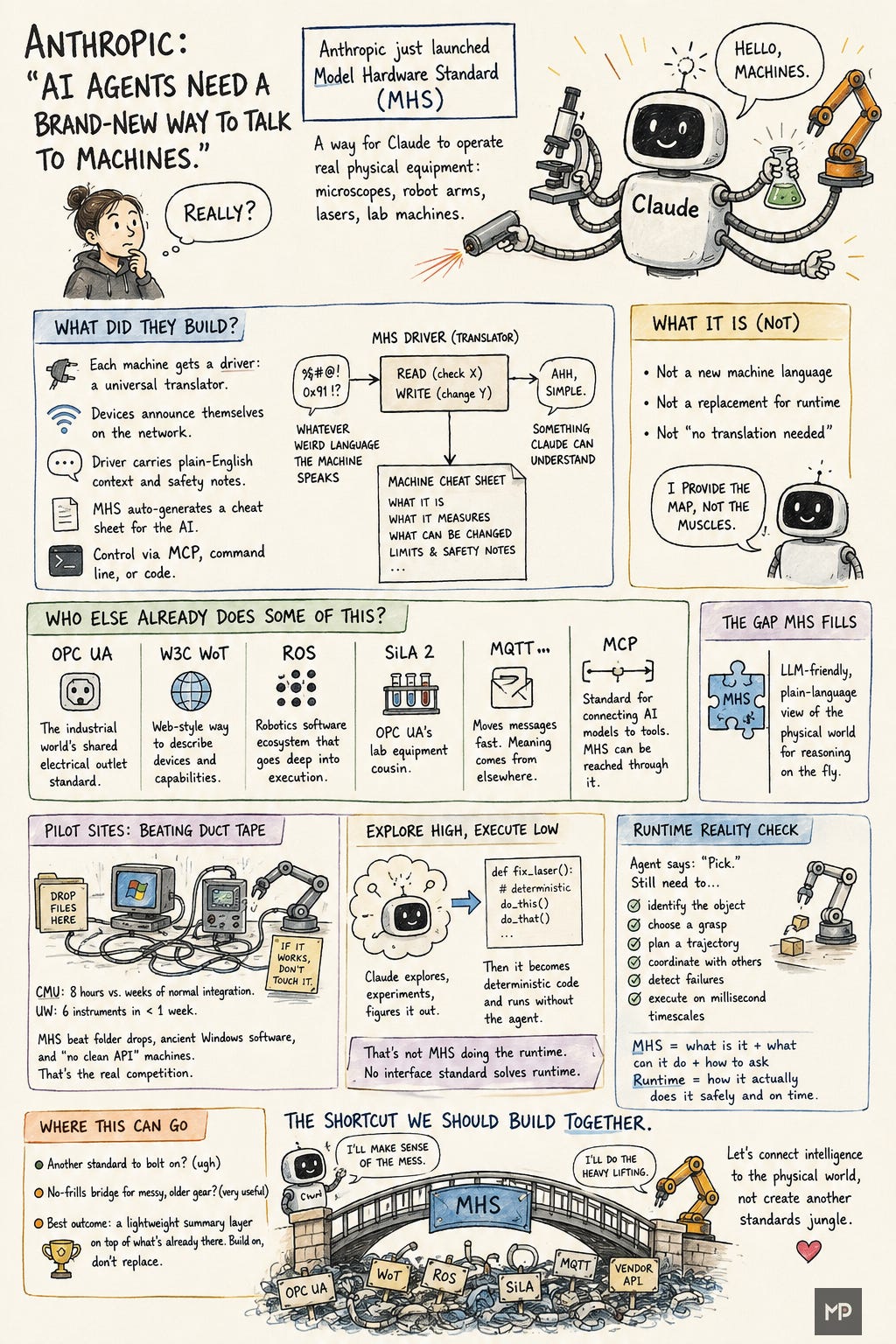

Anthropic last week: AI agents need a brand-new way to talk to machines.
Really? I read through the news again, and it seems to be blurring some lines with that statement - but what MHS is, is actually more interesting than its positioning. Anthropic may be doing itself a disservice with its current positioning.
This is the line in their announcements that made me go - really?
Each device tends to have its own programming interface, and so far there has been no standardized way to integrate them. (Anthropic announcement MHS)
As someone who has worked in the industrial tech space for a while, that just seems way too broad, so i started reading up on it. Here’s what I think.
Short version upfront:
Anthropic just launched the Model Hardware Standard (MHS) which is a way for Claude, to operate real physical equipment: microscopes, robot arms, lasers, lab machines. Anthropic’s pitch is that there has been no standard way to integrate this kind of heterogeneous hardware for AI agents.
Now that sweeping claim claim needs some dissecting. The industrial world has had ways to connect machines together for decades. What is new however, is that MHS is specifically built for an LLM, not for traditional software. The metrics Anthropic released have also been pretty solid - an 8 hour lab integration that used to take weeks, and a laser-recovery script that went up from 58% 99% reliability.
There are a lot analyses and posts on this topic which roughly all seem to be implying - “Anthropic invented something from nothing.” That’s too broad a brush and not completely accurate.
I found the MHS to be narrower (happy to be shown I’m wrong as I’m still trying to figure it out) BUT also that narrower piece to be more useful than another (!) standard way to integrate hardware.
Anthropic has built a cheap shortcut through what is a genuinely expensive, boring problem, aimed at AI agents.
What has Anthropic actually built
Here’s how I think it works:
Each machine gets a driver: so a universal translator which takes whatever proprietary language a machine speaks and converts it into two simple commands: read (check X) and write (change Y).
Devices announce themselves on the network, so an AI agent can find them automatically, instead of someone hard-coding a connection.
The driver also carries natural language notes about the machine like how much does a robot arm weigh, what are its safety limits, etc. The kind of things that used to live only in a PDF or in a technician’s head.
From all of this, the MHS auto-generates a cheat sheet describing the device, what it measures, what can be changed, and where the limits are.
The AI agent can then control the device in three ways: A tool-connection standard (MCP), command line, or through code.
MHS is at the same time being a translator, a phone book (device discovery), a cheat sheet (device description), a control panel, and a way to turn what the AI learned into a fixed, repeatable script.
The name Model Hardware Standard however is suggesting a hardware standard. What it actually is, is one layer up: a translation layer that helps an AI understand and operate machines to work as Business as Usual/how they already do. The robot’s own internal software doesn’t change. Someone still has to build the translator for each new machine - Anthropic’s early partners are doing that now, one instrument at a time (CMU, genentech, Washington uniersity, QIAGEN…)
And I didn’t find anything when I searched for whether Anthropic is building this together with the organizations that are already common in this space (OPC UA and WoT for e.g.). Its list has labs, robotics companies, and cloud providers, but not existing standards bodies. Is it building as an island? Or is it just moving faster than they are?
For anyone who is interested - who else already does this?
OPC UA: One of the closest things industrial automation has to a common machine language. Decades old, pretty exhaustive, used by manufacturing worldwide. The industrial world’s version of an electrical outlet standard. If a machine speaks OPC UA, I’d expect most industrial software already knows how to talk to it.
W3C Web of Things (WoT): A simple, web-style version of the same concept: describe a device’s readable state, its available actions, and its notifications, the same way a website describes its own structure.
ROS: Widely used open robotics software ecosystem. Less about connecting a robot to the outside world and more about how the robot’s own brain and body parts talk to each other. Goes much further into robot execution than MHS, though many commercial robots still run proprietary runtimes underneath.
SiLA 2: OPC UA’s purpose-built lab equipment cousin.
MQTT: Moves messages between devices quickly and reliably, but something else has to supply the meaning.
MCP (Model Context Protocol): Anthropic’s own standard for connecting AI models to software tools. MHS gives physical devices a common agent-facing representation that can be reached through MCP. While Anthropic created MCP, it is an open protocol so another ecosystem could potentially go the Agent>MCP>ROS/Vendor API/OPC UA way
Every one of these already does some version of what Anthropic says doesn’t exist: describe a machine, expose its state, let other software ask it to do something.
But what none of them were built for specifically, is an LLM that needs a lighter, plain-language version of all that. One it can reason about on the fly (instead of parsing like a traditional program) - That’s the gap MHS is actually filling. It’s a real gap. It’s just narrower one than “nobody solved this before.”
While the claims are broad/ more marketing maybe - but if we narrow them down, they solve a really good AI specific problem.
The real way to say “No standardized way to integrate them” is that there’s no standard built specifically for AI agents, that has actually gained traction across the broad range of odd, older equipment out there. Maybe that’s less glamorous, though a very real gap.
Anthropic also says - “No bespoke translator program needed.” Well…the MHS driver is the translator. CMU researchers wrote one up from scratch for every single instrument. Good news is that MHS makes it happen once per device instead of once per pair of devices trying to talk to each other. While this is really useful, It’s not the same as not needing translation.
“The reference file gives the AI “everything it needs to know.” The reference file can tell Claude what the machine exposes, what changed, and what limits apply. It can’t contain every piece of physical or operational knowledge the agent may need. MHS can package machine context well, but some of the understanding still has to come from the model, a human, or additional domain knowledge.
“Safely operate physical devices” is the design goal. Anthropic will be using the preview phase to develop safety evaluations, permissions, and best practices around physical operation before opening the standard more broadly.
Whether in preview or not, how much of that safety can live in an agent-facing layer, and how much must remain in the certified controllers, limits, and runtime systems underneath it?
Let’s look at the MHS pilots to figure out what MHS is really solving for
in the CMU lab there was a liquid handler, a plate reader, a robot arm, and cameras spread across three different computers 1/ one controlled by dropping files into a folder, 2/ one running ancient Windows software 3/ one with no clean programmatic API. Building the AI-driven version took 8 hours. A normal vendor-built setup takes a few weeks.
MHS didn’t beat out OPC UA or another modern standard. It fought out file-drop, ageing Windows software, and a machine with barely more than a screen. That’s a very different, but a very common, challenge.
At the University of Washington, one researcher connected 6 lab instruments in less than a week and used it for remote monitoring and running experiments. This is pretty cool, even though this is still early-stage and more complex setups will need more work.
The theme is that these machines mostly had no shared standard to begin with.
From my perspective, MHS’ main competition isn’t existing standards, it’s the duct tape which comes with having none. A thin, cheap translator + plain-language notes is much less painful than months of formal integration work that is usually required. Or the alternative is someone moving lab plates by hand at 4 a.m.
So now this kind of thing exists. What does that mean?
What if the incumbent standards can absorb the agent layer? In fact, a few months before the MHS launched, the OPC Foundation has started converting its entire library of specifications into AI-friendly formats. It aims to become the semantic layer between agentic AI and industrial automation. WoT is also evolving what is already an easily digestible device-description model to do similar things.
Now if either the OPA UA or WoT deliver a clean,bridge from their existing systems straight to an AI agent, a lot of the reason to use MHS in a modern factory can disappear. While Anthropic has the advantage of moving first with an agent-native hardware layer, but OPC has the harder-to-copy advantage of having theinstalled base of industrial adoption. So will Anthropic end up serving a different market, or will it be a best-man-wins parallels, or will they converge, or will we have even more of a standards maze?
Within the standards world, honestly, adoption matters more than purity. Once enough labs and manufacturers build their tools, skills, and workflows around one system, switching is expensive, even if another approach is technically cleaner. If MHS spreads fast through labs and startups over the next year, that itself can give it an advantage. Small labs and startups especially can benefit a lot, as they can’t afford months of custom automation engineering but MHS can lower the price barrier enough that it expands who gets to run automated, round-the-clock experiments: not just big pharma and elite university labs, but smaller ones too.
The MHS developments, along with what other bodies are doing can go in a few directions.
MHS could be one more standard manufacturers are expected to bolt on top of everything else they already need to support. I don’t think any manufacturer would want to do this!
MHS could become an affordable no-frills way to connect fragmented, older equipment - the file-drop folders and dead-GUI machines of the world. This would be very valuable independent of what OPC UA or WoT do.
Or MHS could move towards collaboration as a lightweight, AI-specific summary layer sitting on top of whatever standard already exists underneath. It can pull from OPC UA, WoT, ROS, or a vendor’s own API, and strip it down to only what the AI actually needs.
This is what I’m hoping happens. Where a mature standard already exists, MHS should build on it, not replace it. Where nothing exists, it can fill the gap cheaply. There have been enough industrial standards wars. A smaller, clearer view of a machine than traditional software provides is useful enough, and everything more rigorous continues running underneath it as is.
Description isn’t Execution. None of this is a runtime.
Even if it/they all work perfectly, an agent discovers a robot, learns it can lift 10kg, knows its current state and invokes “pick”… something still have to in the physical world, identify the object, choose a grasp, plan a collision free trajectory, coordinate with the other equipment, detect a failed try, and execute the motion within timings where no one’s waiting for an LLM to finish thinking. That’s a different physical AI layer.
MHS = what is this machine, what can it do, how can an agent ask it to do something
Robot runtime, planner, PLC controller = how does the system actually do it safely and on time
In the Anthropic’s QuEra example, Claude used MHS to work through a laser recovery problem and achieved success in almost all trials but the finished process did not mean Claude controlled the laser. It became deterministic Python and ran without the agent. Explore high, execute low.
MHS’ strongest value proposition is the place where an agent gets a simplified view of the physical world.
It sits across the network of the existing machinery. OPC UA has the deep industrial semantics. WoT describes describe devices and capabilities. ROS and other proprietary runtimes handle robot execution. MQTT moves messages. Controllers act deterministically…where a mature standard is already existing, MHS can translate or compress it so agents can reason about it. Where nothing exists, it wraps around it directly.
I don’t think we need another standards race, but I do think in a field like Physical AI, we need a little more collaboration.
I’d like to avoid solving interoperability at the physical layer, just to create another interoperability problem one layer up - MHS in places, an OPC-to-agent interface somewhere else, direct agent>MCP>OPAUA/vendor API/ROS in other places, other model companies having their own versions…
Autonomous machines are complex, they need both - a solid way for agents to discover and reason about physical capabilities, as well as runtimes and controllers turning requests into safe, deterministic action.
While Anthropic’s positioning may be selling a new standard, it is actually building a shortcut through the standards, APIs and assorted duct tape we already have which would be way more useful. But this shortcut needs to become more interoperable before everyone builds their own.
Pallavi Chari, Moving Parts
Oh an here’s a comic strip infographic because I wanted to see what AI would do to my article and this post felt like it deserved one!